
Plantar Warts: Symptoms, Causes & Treatment
Everything you need to know about plantar warts - what they look like, how they develop, how to tell one from a corn, and the treatments that actually clear them.
Plantar warts are one of the most common skin conditions affecting the feet. They can show up as a small, rough patch on the sole of your foot and, for many people, go unnoticed at first. But left untreated, a plantar wart can grow, multiply, and become quite painful to walk on.
Whether you have just noticed something unusual on your heel or you have been dealing with a stubborn wart for months, this guide covers what to look for and the professional treatment options available at Bexley Podiatry: Foot & Ankle Clinic for patients across Bexley, Rockdale and the wider St George area.
- 1 in 10 Australians are affected by warts at any given time.
- HPV is the virus responsible for all plantar warts.
- 83% is the reported success rate of Swift microwave therapy.
What is a plantar wart?
A plantar wart (also called verruca plantaris) is a small, rough skin growth that develops on the soles of the feet. The word plantar simply refers to the underside of the foot, which is where these warts typically form.
Plantar warts are caused by specific strains of the human papillomavirus (HPV). The virus enters the skin through tiny cuts, cracks or abrasions, usually in warm, moist environments like public pools, gym change rooms or communal showers.
Unlike warts elsewhere on the body, a plantar wart is forced inward by the pressure of walking and standing. That is what makes them so uncomfortable - the wart grows into the deeper layers of skin rather than outward, and constant pressure on the sole can make every step feel like you are walking on a small stone.
Clinical note
Plantar warts are not the same as corns or calluses, though they can look similar. The key difference is that warts are caused by a virus, while corns and calluses result from friction and pressure alone. A podiatrist can accurately diagnose which one you have.
Signs and symptoms to watch for
Recognising plantar wart symptoms early gives you the best chance of treating them before they spread or deepen. The most common signs are:
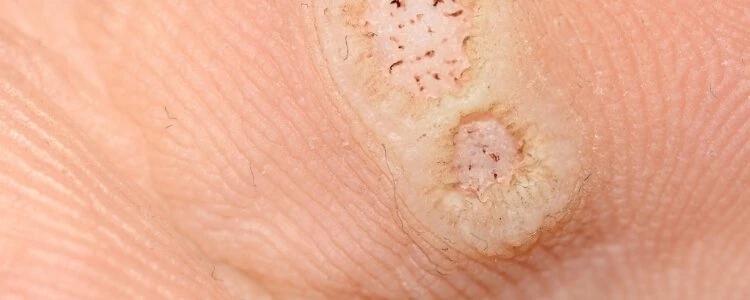
- Tiny black dots - small dark specks within the wart. These are clotted blood vessels feeding the wart tissue, often called wart seeds, though they are not actual seeds.
- Rough, grainy texture - the surface is typically hard and rough, and may feel bumpy or cauliflower-like.
- Pain when squeezed - warts hurt when pinched from the sides rather than pressed directly. This squeeze test helps distinguish them from corns.
- Disrupted skin lines - the natural ridges of the skin on the sole are interrupted around a wart. Corns and calluses do not disrupt these lines.
- Thickened overlying skin - a wart often builds a layer of hard, yellowed skin on top, which can make it look like a callus until you examine the centre.
- Wart clusters (mosaic warts) - multiple warts that merge into a flat, patchy area. These tend to resist treatment and need professional care.
When to act
If your wart is bleeding, changing rapidly in appearance, or causing pain that affects how you walk, do not wait. Book an appointment with your podiatrist promptly.
Early stage plantar warts
Catching a plantar wart early makes treatment considerably simpler. An early stage plantar wart often looks nothing like the textbook images you find online, which is exactly why so many people dismiss them until they become harder to treat.
What does an early plantar wart look like?
In the earliest stages, a plantar wart may appear as a very small, flat, rough patch of skin, perhaps 2 to 3mm across. It may be slightly lighter or darker than the surrounding skin and may not yet have the characteristic black dots. At this stage it is often painless.
As the wart develops, the black dots begin to appear, the surface becomes more raised or textured, and walking on it starts to feel uncomfortable. This progression can take weeks to months, depending on how your immune system responds to the virus.
- Early - a small flat rough patch, 2 to 4mm, with minimal black dots. Often painless or slightly sensitive. Monitor closely and see a podiatrist if unsure.
- Developing - a raised, textured surface with visible black dots, and mild discomfort when walking. Book a podiatry assessment.
- Advanced - deep and hardened, sometimes forming clusters, with significant pain and an altered gait. Prompt professional treatment is required.
Good to know
Early-stage plantar warts are the quickest and easiest to treat. If you spot something unusual on the sole of your foot that has not gone after a couple of weeks, have it checked - early treatment usually needs fewer appointments and causes less disruption.
Where plantar warts appear
While the sole is the most common site, plantar warts and other verrucae can appear in several places. Here is what to look for depending on where you notice a suspicious growth.
On the sole of the foot
The most common location. Warts typically develop on the heel, the ball of the foot, or the base of the toes - weight-bearing areas where the virus can enter through micro-cracks in the skin.
On the toe
A wart can develop on the top, tip or underside of a toe. Toes are particularly vulnerable in shared footwear environments such as gym locker rooms.
On the fingers and hands
Warts on the hands are technically called periungual or common warts. They can spread from the feet through hand contact and tend to appear near the nail edges and fingertips.
Between the toes
Warts in the web spaces between the toes are common in people who walk barefoot in moist environments. The warm, damp skin there provides ideal conditions for the virus.
Did you know?
Spreading a wart from your foot to your hand is possible, particularly if you pick at or touch the wart and then touch broken skin elsewhere. Always wash your hands thoroughly after touching any wart, and never share towels or footwear with someone who has an active wart.
What causes plantar warts?
All plantar warts are caused by the human papillomavirus (HPV), specifically strains 1, 2, 4 and 27. These are not the same strains associated with cervical cancer - plantar wart HPV is entirely localised to the skin.
The virus thrives in warm, moist environments and can survive on surfaces for extended periods. You are most at risk in places like:
- Public swimming pools and communal pool surrounds
- Gym change rooms and showers
- Yoga studios and martial arts training areas
- Shared towels, socks or footwear
- Walking barefoot on contaminated floors
Not everyone who comes into contact with HPV will develop a wart. Your immune system plays a significant role - children and teenagers develop plantar warts more often than adults, and people with weakened immune systems are at higher risk of persistent or widespread warts.
Diagnosis: plantar wart vs corn
Plantar warts and corns are the two conditions most often confused with each other. Both appear on the sole, both can be painful, and both can develop a hard, yellowish cap of thick skin. Here is how to tell them apart:
- Cause - a wart is caused by the HPV virus; a corn is caused by friction and pressure.
- Black dots - often present in a wart, never in a corn.
- Skin lines - interrupted around a wart, but they pass uninterrupted through a corn.
- Squeeze test - a wart is painful when squeezed from the sides; a corn is not.
- Direct pressure - a wart may or may not hurt; a corn is typically painful when pressed.
- Contagious - a wart is; a corn is not.
If you are unsure which you have, a podiatrist can diagnose it accurately, usually by visual inspection alone and sometimes with gentle debridement to expose the wart structure beneath the surface skin.
Treatment options for plantar warts
Some plantar warts do resolve on their own, but this can take months or even years. Professional treatment speeds up resolution, reduces the risk of spreading, and stops the wart growing deeper and more painful.
At your assessment, your podiatrist will consider the size, depth, location and duration of the wart before recommending the most appropriate treatment.
Debridement
The podiatrist carefully removes the hard, overlying skin covering the wart. This is usually the first step in any treatment plan, as it lets topical treatments penetrate more effectively and confirms the diagnosis.
Topical acid therapy
Salicylic acid and other medical-grade preparations are applied to break down the wart tissue over a series of appointments. Clinical-strength preparations used by podiatrists are significantly more effective than over-the-counter pharmacy options.
Cryotherapy
Liquid nitrogen is applied to freeze the wart tissue, triggering the body's immune response and causing the tissue to die. Cryotherapy may cause temporary blistering and redness, which settles within a few days.
Swift microwave therapy
Swift is a clinically proven microwave-based treatment that delivers a precise dose of energy directly into the wart tissue, heating and destroying it while triggering a strong immune response. It carries a reported efficacy rate of around 83% and requires no dressings, no open wounds and no downtime.
Needling procedure
A specialist technique where fine needles are used to disrupt the wart tissue and stimulate a targeted immune response. It is particularly effective for warts that have not responded to topical treatments.
Surgical removal
Reserved for warts that are deep, persistent and unresponsive to other treatments, and performed under local anaesthetic. There is a small risk of scarring on the weight-bearing areas of the foot, so this is generally a last resort.
Important
Do not attempt to cut out a plantar wart at home. It can cause bleeding, introduce infection and leave scarring on the sole of your foot. Cutting does not remove the virus - the wart will simply regrow. Always seek professional treatment.
Prevention tips
You can significantly reduce your risk of developing plantar warts with a few straightforward precautions:
- Always wear thongs or sandals in public pools, gym change rooms and communal showers.
- Keep your feet clean and dry - change socks daily and let footwear air out between uses.
- Never share towels, socks or shoes with others, even family members.
- Avoid walking barefoot in shared, high-traffic areas.
- Inspect your feet regularly and act quickly if you spot any unusual skin changes.
- Wash your hands thoroughly after touching your own feet or any wart.
- Cover any cuts, cracks or abrasions on your feet before entering public areas.
- Keep your immune system strong - a healthy diet, regular exercise and adequate sleep all help your body suppress the virus.
When to see a podiatrist
While some plantar warts resolve without intervention, there are situations where professional care is necessary rather than optional. Book an appointment if:
- The wart is painful and affecting your ability to walk normally.
- You have tried over-the-counter treatments for more than 6 weeks without improvement.
- The wart is spreading, or new warts are appearing nearby.
- You have diabetes, poor circulation or a compromised immune system.
- The wart is bleeding or shows signs of infection such as redness, swelling or discharge.
- You are unsure whether what you have is a wart, a corn or another condition.
- You have a wart on or between the toes that is causing nail-related issues.
- Your child has a plantar wart - see children's podiatry, as warts in children can spread rapidly.
Noticed a suspicious spot on your foot?
Do not leave it to chance. Our podiatrists at Bexley Podiatry: Foot & Ankle Clinic, 390 Forest Road, Bexley NSW 2207, can accurately diagnose plantar warts and recommend the most effective treatment for your situation - whether it is a small early-stage wart or a stubborn, recurring one. Read more about how we treat plantar warts, or book online to get started.
Related on our site
Reviewed by Dr Hasan Hamad, BHSc, MPodMed. This article is general information, not a diagnosis - for advice about your own feet, book an assessment.
Frequently asked questions
Are plantar warts contagious?
Yes. Plantar warts are caused by HPV, which is contagious and spreads through direct contact with infected surfaces or skin. You can pick up the virus from contaminated floors, towels or footwear, and you can also spread an existing wart to other areas of your own body if you touch it and then touch broken skin elsewhere.
Will a plantar wart go away on its own?
Some plantar warts do resolve naturally as the immune system clears the infection, but that can take anywhere from a few months to several years. In the meantime the wart can grow larger, become more painful and spread. Professional treatment is far more reliable and significantly faster than waiting.
How can I tell if I have a plantar wart or a corn?
Try the squeeze test: pinch the skin around the lesion from the sides rather than pressing directly on it. A plantar wart will typically hurt when squeezed from the sides, whereas a corn will not. Warts also often show small black dots in the centre and interrupt the natural ridged lines of the skin. If you are still unsure, see your podiatrist for a definitive diagnosis.
How long does plantar wart treatment take?
It depends on the method and on the size and depth of the wart. Early-stage warts treated with topical acid therapy may resolve in 4 to 6 appointments over a few weeks. More established warts may need 6 to 10 sessions. Swift microwave therapy often achieves resolution in 3 to 4 sessions. Your podiatrist will give you a realistic timeline at your initial assessment.
Can plantar warts spread from my foot to other parts of my body?
Yes. If you touch a plantar wart and then touch broken or vulnerable skin elsewhere, including your hands, fingers or other areas of your foot, you can spread the virus. This is why covering warts during treatment, washing your hands regularly and avoiding picking at them matters.
Why do I keep getting plantar warts after treatment?
Once you have contracted HPV, the virus can remain dormant in your system even after a wart has resolved, so recurrence is always possible. Good foot hygiene, avoiding barefoot contact with shared surfaces and keeping your immune system healthy all help reduce the risk of future warts.