
Pain on Top of Foot: Causes, Symptoms & What a Podiatrist Can Do
Extensor tendonitis, a stress fracture or nerve compression from tight shoes - pain across the top of the foot has several causes that look alike but need very different treatment. Here is how to tell them apart.
Quick answer
Pain on top of the foot is most commonly caused by extensor tendonitis, a stress fracture, or nerve compression from tight footwear. Most cases respond well to conservative treatment - rest, footwear changes, orthotics and rehabilitation - but getting an accurate diagnosis first is critical. If the pain has lasted more than a week, worsens with walking, or comes with swelling or bruising, book in with a podiatrist promptly.
That ache across the top of your foot when you pull on your shoes. The sharp twinge mid-stride that makes you slow to a limp. Pain on top of the foot is one of the most common complaints we see at Bexley Podiatry: Foot & Ankle Clinic, and it is also one of the most frequently mismanaged, because the cause is not always obvious from the outside.
The top of your foot, the dorsum, is a tightly packed area of tendons, nerves, small bones and joints. There is very little padding between the skin and the structures underneath, so any inflammation, compression or structural damage tends to make itself known quickly and painfully. The right treatment depends entirely on what is actually going wrong - and getting that wrong means weeks or months of unnecessary suffering.
This guide covers the most common causes, how to recognise your symptoms, and what a podiatric assessment and treatment plan looks like for patients across Bexley, Rockdale and the wider St George area. If you would rather skip straight to getting seen, book online.
Why the top of the foot is vulnerable
The dorsum contains several extensor tendons - the tendons responsible for lifting your toes and foot upward when you walk. They run from the muscles in the lower leg, cross the ankle and spread out across the top of the foot to attach to the toes, sitting just beneath the skin with minimal cushioning.
Running alongside those tendons are branches of the dorsal cutaneous nerve, which supplies sensation to the top of the foot. Underneath, a network of small metatarsal bones and midfoot joints forms the structural platform your foot relies on every time you bear weight. Any one of these structures can become the source of significant pain when things go wrong.
What causes pain on top of the foot?
There are several distinct conditions that produce pain in this area. They look similar from the outside but require very different approaches to treat effectively.
Extensor tendonitis
Inflammation of the extensor tendons running across the top of the foot. This is the most common cause overall, typically triggered by overuse, sudden increases in activity, or tight shoe lacing. The pain tends to be diffuse across the top of the foot and worsens with walking or running.
Metatarsal stress fracture
A small crack in one of the long bones of the foot, usually from repetitive impact, and common in runners, dancers and military personnel. The pain is sharp, focal and located at a specific bony point. Tenderness is pinpoint rather than diffuse.
Nerve compression
Tight shoe uppers or laces can compress the dorsal cutaneous nerve branches, producing burning, tingling or numb pain across the top of the foot. Symptoms often ease as soon as the shoe comes off. It is sometimes called shoe bite neuropathy.
Midfoot arthritis
Degenerative change in the joints of the midfoot, particularly the tarsometatarsal joints, causes a deep aching pain that often stiffens overnight and worsens through the day. It is more common in adults over 50 and in people with previous midfoot injuries - see foot and ankle arthritis.
Lisfranc injury
Damage to the ligaments or bones at the tarsometatarsal joint complex, known as the Lisfranc joint. This ranges from a mild sprain to a serious fracture-dislocation and is often underdiagnosed. Signs include bruising on the sole of the foot, significant swelling on top, and severe pain with weight-bearing.
Ganglion cyst
A fluid-filled lump arising from a joint or tendon sheath. On the top of the foot it appears as a firm, rubbery bump and causes pain through direct pressure from footwear, or by compressing nearby tendons and nerves.
Dorsal bone spurs
Bony outgrowths on the top of the foot, often associated with osteoarthritis or old injuries. They can rub against shoe uppers and cause localised pain and skin irritation, or directly impinge on nearby tendons.
Gout
Uric acid crystals depositing in the foot joints cause sudden, severe pain that can affect the top of the foot. Attacks typically come on rapidly, often overnight, producing intense redness, heat and swelling. Any joint in the foot can be affected, not just the big toe.
Seek assessment promptly if you have
Significant swelling or bruising after an injury, an inability to bear weight, numbness or tingling that does not resolve, redness and warmth in the area, or pain that has not improved after one week of rest. These signs suggest a condition that needs imaging and professional management, not just time.
How do I know what is causing my top of foot pain?
The location, character and triggers of your pain are the first clues your podiatrist will use to narrow down the cause. Here is what different presentations tend to suggest:
- Diffuse ache across the whole top of the foot, worse when walking - extensor tendonitis, the most common cause.
- Sharp, pinpoint pain on one bony spot, worse with impact - a stress fracture. Seek imaging promptly.
- Burning, tingling or numbness across the top of the foot - nerve compression, usually footwear-related.
- Deep, stiff ache that is worse in the morning and after rest - midfoot arthritis.
- Sudden severe pain, redness and heat, often overnight - gout, which requires blood tests and dietary review.
- A rubbery lump visible on top of the foot with local pain - a ganglion cyst.
- Severe pain and bruising after a twisting injury or fall - a Lisfranc injury. Urgent assessment required.
Keep in mind that symptoms often overlap, and more than one condition can be present at the same time. A thorough biomechanical assessment by a podiatrist, rather than a symptom checklist, is the only reliable way to confirm what is going on.
How does a podiatrist diagnose top of foot pain?
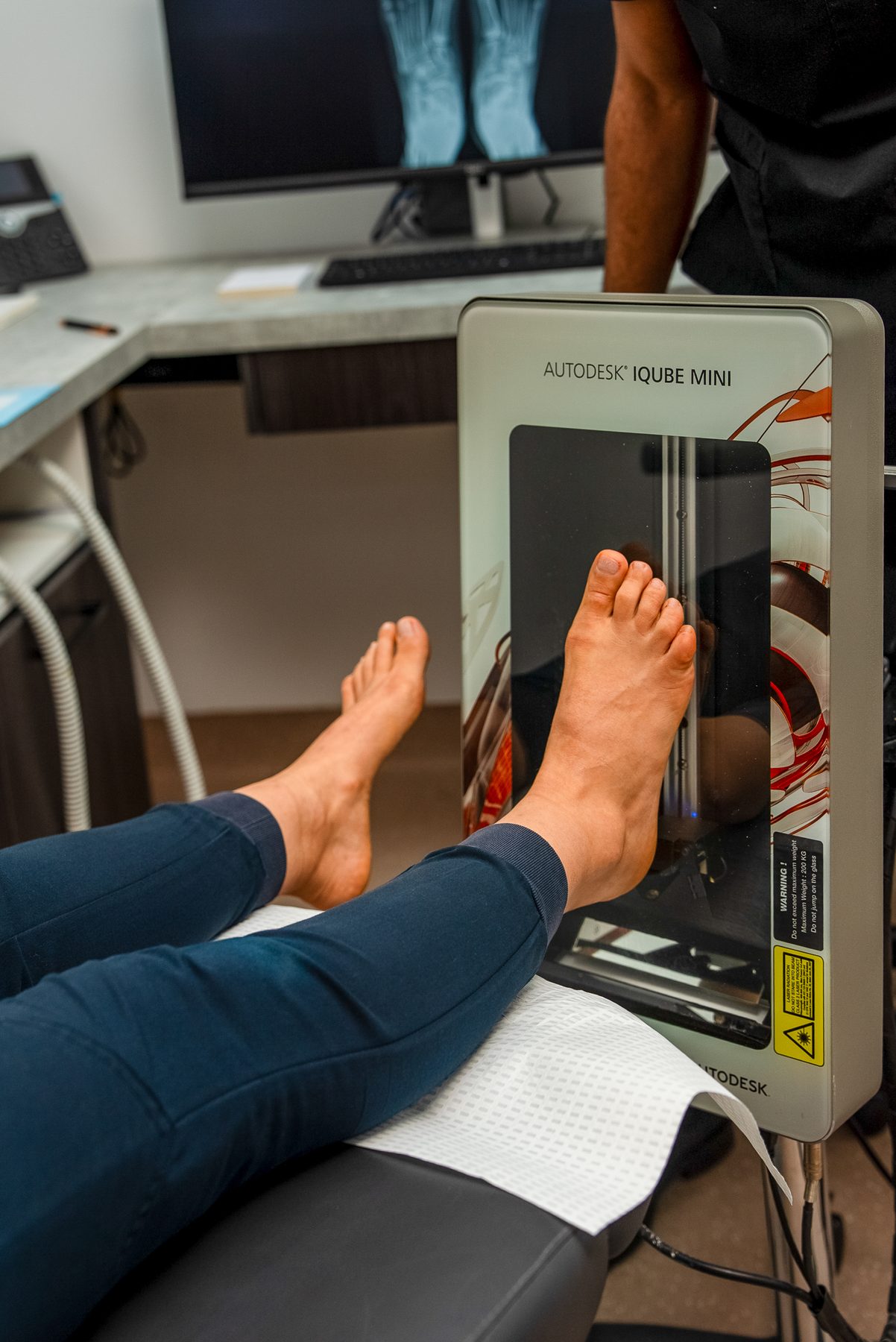
Our initial assessment for top of foot pain includes a systematic review of your history, a physical examination and a gait analysis. Biomechanical consultations are booked for a minimum of 40 minutes, because a rushed diagnosis leads to the wrong treatment plan.
- History taking - when did it start, what makes it worse, and have you changed your activity level, footwear or training load recently?
- Physical examination - palpation of specific tendons, joints and bony landmarks to localise the pain source.
- Gait and biomechanical assessment - how your foot moves through the gait cycle affects load distribution and often reveals the mechanical cause of overuse injuries.
- Footwear evaluation - assessing whether your current shoes are contributing to the problem, a critical and frequently overlooked factor.
- Imaging when indicated - X-ray to assess for fracture or bone spurs, ultrasound for tendon and soft tissue detail, and MRI for complex presentations including suspected Lisfranc injury or a stress fracture not visible on X-ray.
What are the treatment options for pain on top of the foot?
Treatment is determined by the diagnosis. There is no one-size-fits-all approach, and attempting to self-manage without knowing the cause often delays recovery significantly.
Footwear modification
For many top-of-foot conditions the first and most impactful intervention is addressing the shoes. That may mean a wider toe box, an adjusted lacing technique, or footwear with appropriate arch support and cushioning. Professional footwear evaluation is part of every consultation.
Load management and activity modification
Reducing or modifying aggravating activities allows inflamed tendons and irritated nerves to settle. This does not always mean complete rest - a structured, graduated return to activity is often more effective and prevents deconditioning.
Custom foot orthotics
Custom orthotics realign the foot, redistribute pressure and correct the biomechanical factors that drive overuse injuries. They are particularly effective for extensor tendonitis caused by flat arches or abnormal foot mechanics, and for midfoot arthritis where offloading the affected joints reduces pain significantly. Unlike simple arch supports from the chemist, ours are custom-made for your specific foot structure.
Rehabilitation exercises
Targeted strengthening and stretching programs address the muscular imbalances and weaknesses that predispose the foot to injury. Your podiatrist will provide a personalised program with clear progressions and milestones.
Shockwave therapy
For chronic or resistant cases of extensor tendonitis, shockwave therapy delivers targeted acoustic energy to the affected tissue, stimulating healing at a cellular level.
Laser therapy
Low-level laser therapy can be used to reduce inflammation and accelerate soft tissue healing, and is suitable for appropriate presentations of tendon and nerve-related foot pain.
Injection therapy
Where conservative measures have not provided sufficient relief, our podiatrists are endorsed for scheduled medicines and can administer cortisone or other injection therapies to manage pain and inflammation directly at the site.
Dry needling
Where muscle tension and myofascial trigger points are contributing to pain and altered movement patterns, dry needling targets these areas to release tension and improve tissue function.
A note on stress fractures and Lisfranc injuries
These two conditions require prompt professional management and should not be treated with self-care alone. Stress fractures need protected weight-bearing and may require a moon boot or offloading device. Lisfranc injuries, even when they appear minor, can lead to long-term joint instability and arthritis if not managed correctly. If you suspect either, contact us the same day.
Can top of foot pain be prevented?
Not all causes are preventable - osteoarthritis and gout have systemic contributors that go beyond footwear choices. But the most common causes, extensor tendonitis, stress fractures from overuse and nerve compression, can often be avoided with a few straightforward habits.
- Choose shoes with a roomy toe box and adequate depth across the top of the foot. Laces tied too tightly are a surprisingly common culprit.
- Increase training loads gradually. The standard guideline is no more than a 10% increase in weekly mileage or intensity at a time.
- Replace athletic footwear regularly. Most running shoes lose significant cushioning and structural support after 500 to 800km.
- Get a biomechanical assessment before symptoms develop if you are an active person - understanding your foot mechanics helps identify vulnerability before an injury takes hold.
- Address flat arches or high arches with appropriate orthotics if your foot type predisposes you to overuse conditions.
- Warm up and cool down properly, including stretches for the calf and extrinsic foot muscles that drive tendon load.
Pain on top of your foot? Get it assessed properly
Our team at Bexley Podiatry: Foot & Ankle Clinic, 390 Forest Rd, Bexley NSW 2207, will identify exactly what is going on and build a treatment plan tailored to you rather than a generic protocol. We are a bulk-billing practice for eligible patients and pensioners on a primary care plan, and Medicare offers up to five podiatry appointments through the Enhanced Primary Care plan. Book online to get started.
Related on our site
Reviewed by Dr Ozan Amir, FACPS. This article is general information, not a diagnosis - for advice about your own feet, book an assessment.
Frequently asked questions
What causes pain on top of the foot?
The most common causes are extensor tendonitis, metatarsal stress fractures, nerve compression from tight footwear, midfoot arthritis and ganglion cysts. Tight shoe lacing, overuse and biomechanical imbalance are the most frequent contributing factors. A podiatric assessment will identify the specific cause and drive the right treatment plan.
When should I see a podiatrist for top of foot pain?
See a podiatrist if the pain has lasted more than a week, worsens with activity, is accompanied by swelling or bruising, or is preventing you from walking normally. Early assessment leads to faster recovery - most people wait too long and turn an acute problem into a chronic one.
Can I walk with pain on top of my foot?
It depends on the cause. Minor extensor tendonitis may allow modified activity with appropriate footwear, but a stress fracture or Lisfranc injury requires immediate rest and professional assessment. Walking on an undiagnosed injury can cause further and sometimes irreversible damage. If you are unsure, get it assessed first.
Do I need an X-ray or MRI for top of foot pain?
Not necessarily. Many cases are diagnosed accurately through a thorough clinical and biomechanical examination. Your podiatrist will recommend imaging when a stress fracture, Lisfranc injury or significant bony change is suspected, and will explain exactly why any investigation is needed before recommending it.
How long does extensor tendonitis take to heal?
With the right treatment, most cases of extensor tendonitis resolve within 4 to 8 weeks. Chronic or untreated cases, particularly those where the underlying biomechanical cause has not been addressed, can persist for months. Starting treatment early makes a significant difference to recovery time.
Can tight shoes cause pain on top of the foot?
Yes, and it is more common than most people realise. Shoes with a narrow toe box, rigid uppers or laces tied too tightly compress the extensor tendons and dorsal nerve branches, causing pain, tingling and over time inflammation. One of the simplest first steps is switching to properly fitted footwear.
What is a Lisfranc injury and is it serious?
A Lisfranc injury involves damage to the ligaments or bones at the tarsometatarsal joint complex, the junction between the forefoot and hindfoot. It ranges from a mild sprain to a complex fracture-dislocation. Even milder Lisfranc injuries are considered serious, because missed or poorly managed cases can lead to long-term instability, chronic pain and arthritis. Classic signs are significant swelling and bruising on top of the foot, and sometimes the sole, after a twisting injury.
Does Bexley Podiatry bulk bill?
Yes. We are a bulk-billing practice for eligible patients and pensioners on a primary care plan. Medicare offers up to five podiatry appointments through the Enhanced Primary Care plan. Speak to your GP about whether you are eligible for a referral before your appointment.